nSpire AI · Flagship
Theo isn't a career co-pilot. That was application #1.
Theo is a conversational assessment engine. Context in. Adaptive conversation. Decision-ready report out. The career co-pilot is just the first thing we pointed it at.
10,000+ hours of mock interviews. ~200× user growth. One engine.
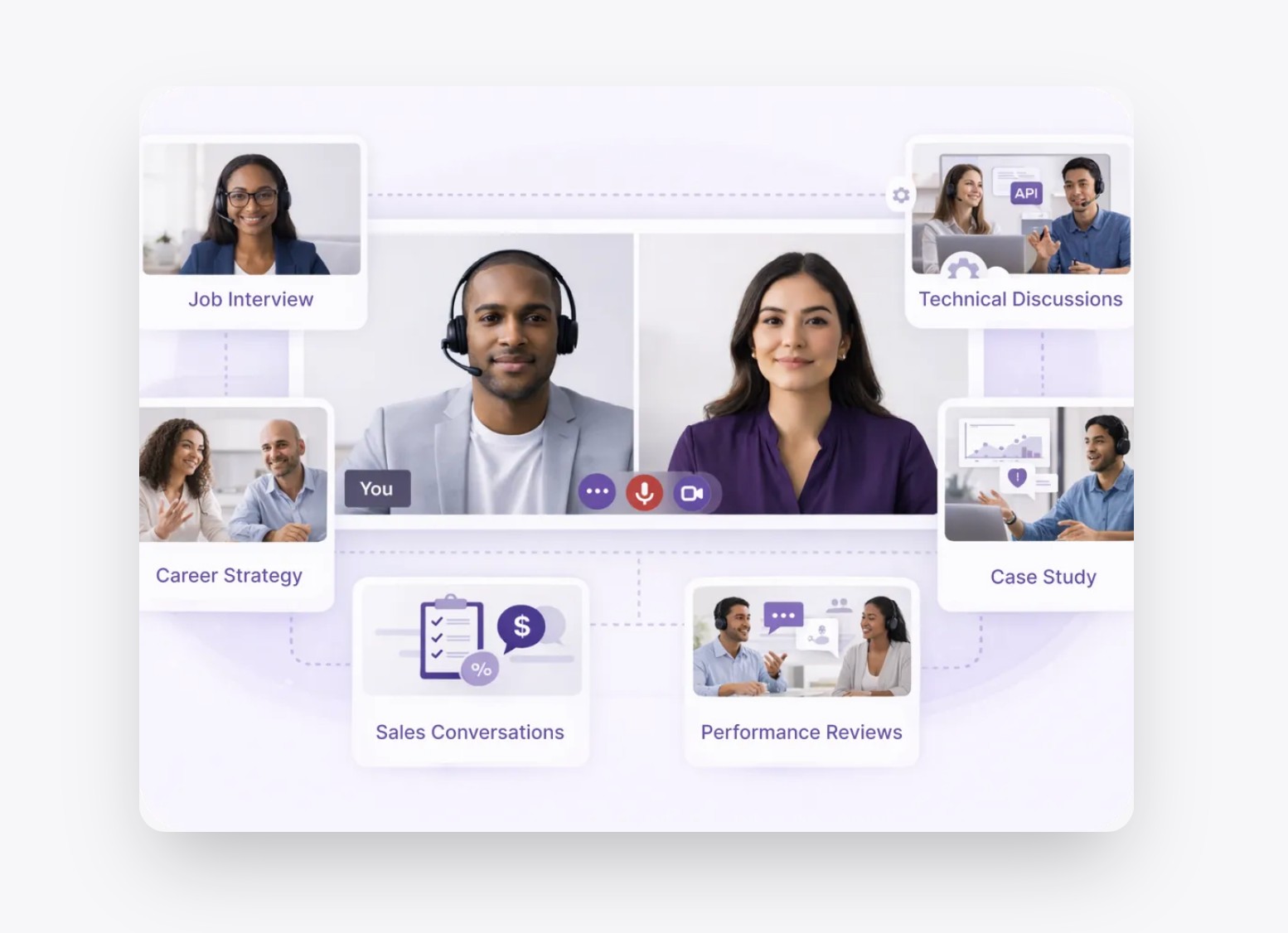
The starting point
Job seekers send 200 applications into the void. They hear nothing back. Not even a why. The tools meant to help? Static templates. Video questionnaires. AI rewriters that paper over real gaps. The output is more applications. Not better candidates. Now flip it. Universities and workforce orgs want to assess capability at scale. They can run 5 mock interviews a quarter manually. They need to run 500. Nobody has built the thing that does both.
The product bet
Theo is a conversational assessment engine wrapped in a career co-pilot. The atomic capability is simple. Resume + JD + role profile go in. A real conversation happens. A decision-ready report comes out. That engine drives the full loop. Resume Optimization. Real-Time Mock Interview. Self-Intro and Behavioral practice. Domain Practice (where users build their own modules). Job Match with paywalled scoring. A normalized job board across feeds. Every surface is the same engine pointed at a different problem. And that engine? It's general-purpose enough to extend into hiring (that's Vera). Sales coaching. Promotion readiness. Anywhere a structured conversation needs to happen at scale.
Why it matters
For job seekers: evidence, not vibes. They practice with real feedback. They see *why* a role fits. They get interview-ready faster. For universities and workforce orgs: the assessment layer they couldn't build themselves. For nSpire: a defensible engine that monetizes clarity, not access. Users upgrade because they want confidence before applying. Not because we're blocking the door.
The numbers
-
10,000+
Hours of mock interviews run
Real practice sessions, not signups.
-
~200x
User growth
From soft launch to today.
-
+20%
14-day retention lift
After consolidating 3 tools into Mock v2.
-
70% → 5%
Post-onboarding drop-off
Driven by the pre-signup Try Theo demo.
-
~10%
Free → paid conversion
Users pay for clarity, not access.
-
80×
AI inference cost reduction
Multi-model routing + prompt optimization via Langfuse.
-
≤2%
Feedback hard-fail rate
Locked metric definition in the PRD. Not vibes.
The rules I built against
-
01
Access is free. Understanding is paid.
Browsing, applying, and core practice stay open. Clarity is the upgrade.
-
02
Evidence over impression.
Every feedback signal has to be transcript-backed. Explainable to the user, the customer, and a regulator.
-
03
Behavior change beats features shipped.
A feature isn't done at launch. It's done when usage and the metric move together.
-
04
Saying no is a product skill.
Every PRD lists what's out of scope. The features you don't build are why the ones you do build actually ship.
The reframe
Here’s the thing nobody tells you about owning a product for a year.
You start by believing the pitch deck. I did. For six months I thought I was building a career tool.
Then the inbound started.
A university asked if we could assess capstone presentations. A workforce org asked if we could replace their consulting screening. A sales leader asked if we could simulate buyer roleplay.
Three different industries. Same underlying ask.
We hadn’t built a career tool. We’d built an assessment engine wedged into careers first.
The atomic capability works anywhere a company today does one of three things. Pays a human a lot of money to run a structured interview. Sends out a form nobody fills out honestly. Or skips the assessment entirely and accepts the blind spot.
That reframe drives every roadmap call now.
We’re not building career features. We’re building the engine. And then we’re pointing it at things.
The engine
Conversational assessment engine
Context in → conversation → report out
- Career Live
Theo · resume, mock interviews, job match
- Hiring Live
Vera · pre-hiring-manager interviews
- Sales coaching Next
Buyer roleplay at scale
- Promotion readiness Next
Internal capability assessment
- Education Next
Capstones, admissions, workforce orgs
Decision: one engine or three tools
Interview practice inside Theo had fragmented into three overlapping tools. Self-Intro. Behavioral. Mock Interview. Users didn’t know where to start. Engineering maintained three brittle logic paths. Feedback quality varied by tool.
Three ways out.
Option A — keep all three, improve each. Lowest migration risk. No data remapping. But it triples every future improvement and does nothing about the entry-point confusion. Fragmentation compounds.
Option B — consolidate into one engine. Mock Interview already had the most scalable architecture. Move Self-Intro and Behavioral inside it as modules. Deprecate the legacy flows. One entry point. One reliability bar.
Option C — build a router. Keep the three tools, add a smart dispatcher that sends users to the right one. Preserves the sunk investment. But it papers over the fragmentation instead of fixing it — three codepaths still exist, plus now a router to maintain.
Direction chosen: B. Consolidate.
The tradeoff. Consolidation meant remapping historical practice data in the Progress Hub — three chart migrations, plus a deprecation plan for every legacy route, email deep-link, and onboarding card that pointed at the old tools. Existing users had to relearn where things lived. I accepted that cost. Fragmentation was compounding with every new user, and the migration pain was one-time.
Result: 14-day retention up ~20%. Feedback hard-fail rate capped at ≤2% with a locked, PRD-level metric definition — a “hard fail” counts only when a user requests feedback and no payload returns. Partial or low-quality feedback is tracked separately. Definitions decided before launch, not after the argument.
What I shipped
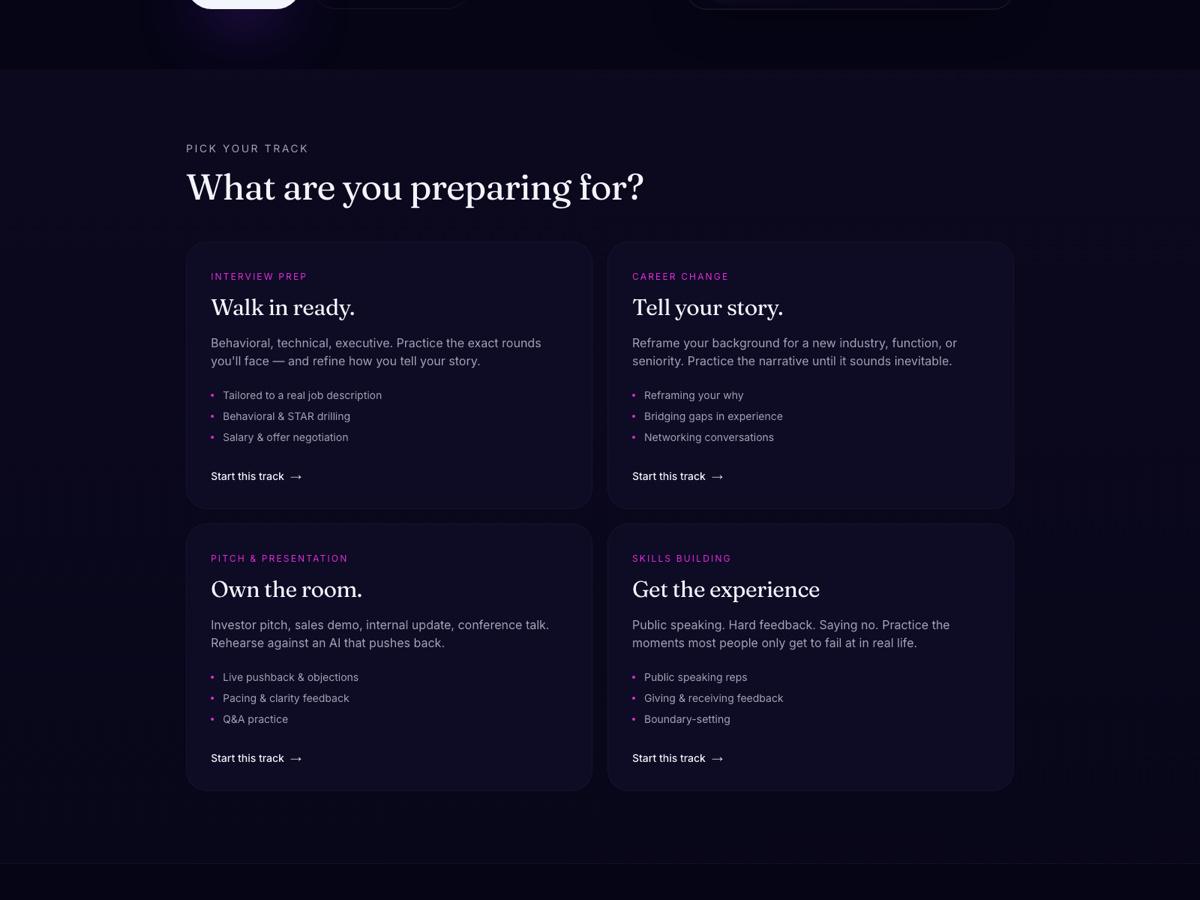
Resume Optimization. Resume + JD in. Initial match analysis. Then a real conversation where the user iterates with Theo to optimize. ATS-ready resume and cover letter out. Not a one-shot rewriter. A back-and-forth that holds context across the whole session.
Real-Time Mock Interview (v2). The consolidation above. Voice in. Camera optional. Killed the feedback hard-fails. One entry point for all non-technical practice.
Job Match + Paywall. Reframed the entire monetization model. Browsing stays free. Understanding (match score + explanation) is paid. People upgrade because they want confidence. Not because we locked them out. Match data persists across downgrade and upgrade cycles so the UX never punishes them.
Domain Practice. Users build their own roles and modules. The engine generates the practice plan, runs the session, returns transcript-backed feedback. Same conversational core. User-defined scope.
This is the cleanest proof the engine generalizes. If a user can configure it themselves, an enterprise customer can too.
Job Board Normalization. Database-level canonicalization. The “AWS vs Amazon vs Amazon Web Services” problem? Fixed. Internal fuzzy matching. External enrichment. Audit-logged. A/B-tested for application lift.
Try Theo (Pre-Signup Demo). A real mock interview, before signup. Sounds small. Wasn’t. This is what moved post-onboarding drop-off from 70% to 5%. People stopped getting funnel-pushed. They started self-selecting in.
The value moment
A real mock interview with real feedback
What it required
Signup, onboarding, and setup — first
User reality
Most bounced before ever feeling the value
What it cost us
~70% post-onboarding drop-off
The flip
Put the mock interview before signup. Drop-off fell to ~5%.
nSpire Referral System. Referrer gets 2 weeks Theo Pro + $10 gift card per conversion. Invitee lands on “Sachin sent you 2 weeks of Theo Pro.” Reward triggers at moments of value. Post-mock. Post-high-resume-score. Post-streak.
Plus everything else running on the engine. Shares + Stories. Journals. Quick Practice. Email Re-engagement Ladder. Full Stripe subscription lifecycle.
What I’d do differently
I spent year one adding surfaces.
I should have spent year one hardening the engine.
The Use Case Landscape doc I wrote (mapping Theo’s possible expansion into hiring, sales coaching, manager enablement, compliance training, education, healthcare, financial services, public sector, B2B2C embedding) was a strategic unlock. It also held up a mirror.
We were building features. We should have been building the engine.
Next 12 months: harden the engine. Deepen the rubric library. Prove the cross-domain thesis by shipping Vera on the same infrastructure.
Recognition
Product School picked their official AI tool stack. OpenAI. Replit. LangChain.
And nSpire AI.
The only career-focused product on the list.
What users said
I find it more useful than other tools I have tried (such as Job Scan), especially in providing specific, non-generic feedback.
The chat-based optimization felt accurate and useful. It made my resume more specific and ATS-friendly.
The detailed scoring plus suggestions helped me know exactly where to improve.