Founder · Acqui-hired
Closet Compass — a brain for your closet
An AI wardrobe assistant that eliminated decision fatigue and made the clothes you already own work harder. Napkin to working AI in 200 hours. Then nSpire bought it — seven days before my flight home.
The starting point
Millions of people struggle with decision fatigue every morning. Studies show **60% of owned clothing goes unworn** — closets full of stuff that earns no hanger space, while fast fashion accelerates the cycle (fashion contributes ~10% of global carbon emissions). Existing wardrobe apps each solve one slice: Stylebook handles digitization but no AI styling; Smart Closet handles outfit logging but no sustainability layer; Cladwell offers curated outfits but no personalization from *your* actual wardrobe. None integrates AI personalization, event-based planning, *and* sustainability tracking into a single experience.
The bet
Closet Compass is an AI-powered wardrobe assistant. Photograph your closet → LLM digitization tags every item → an adaptive styling engine recommends outfits based on **what you actually own, the weather, and what's on your calendar**. Three differentiators that no competitor combined: (1) an AI styling algorithm that continuously learns from user preferences, (2) a sustainability matrix that tracks wardrobe usage data and surfaces underutilized items, and (3) seamless feature integration — weather + event-based outfit planning + social sharing in one flow. Freemium model: wardrobe digitization and basic suggestions are free; premium ($4.99/mo) unlocks AI styling, sustainability insights, and event-specific planning. Affiliate partnerships on the brand side close the loop ethically — recommend filling actual wardrobe gaps, not generating impulse purchases.
Why it matters
For users: wear more of what you already own. Less morning decision-fatigue, less impulse buying, less guilt about clothes with tags still on. For the broader system: a sustainability play that pays out economically — buy less, wear more, and the styling intelligence becomes the engagement loop instead of constant new-arrival pushes. We validated this thesis through the NSF I-Corps customer discovery program with 30+ structured interviews, then in beta with ~40% DAU among users who joined the waitlist. The qualitative pattern was consistent: people don't want more clothes; they want help with the ones they already own.
The numbers
-
1,000+
Waitlist signups pre-launch
-
~40%
Beta DAU
-
30+
I-Corps customer discovery interviews
-
500+ in 2 weeks
Instagram organic growth
-
200 hours
Napkin sketch → working AI
-
$4.99/mo
Premium price point
-
90M US Gen Z + Millennials
Target SAM
-
Acqui-hired by nSpire AI
Outcome
The market thesis
The global fashion-tech market was projected to hit $4B by 2025, growing at ~8.9% CAGR. Inside that, the Serviceable Available Market — Millennials and Gen Z in the US who prioritize convenience and sustainability — sits around 90M consumers. The early-adopter pool (fashion-forward professionals + eco-conscious users) is roughly 1M. We weren’t selling to fashion enthusiasts; we were selling to anyone tired of standing in front of their closet at 7:42am feeling already late.
What I actually shipped
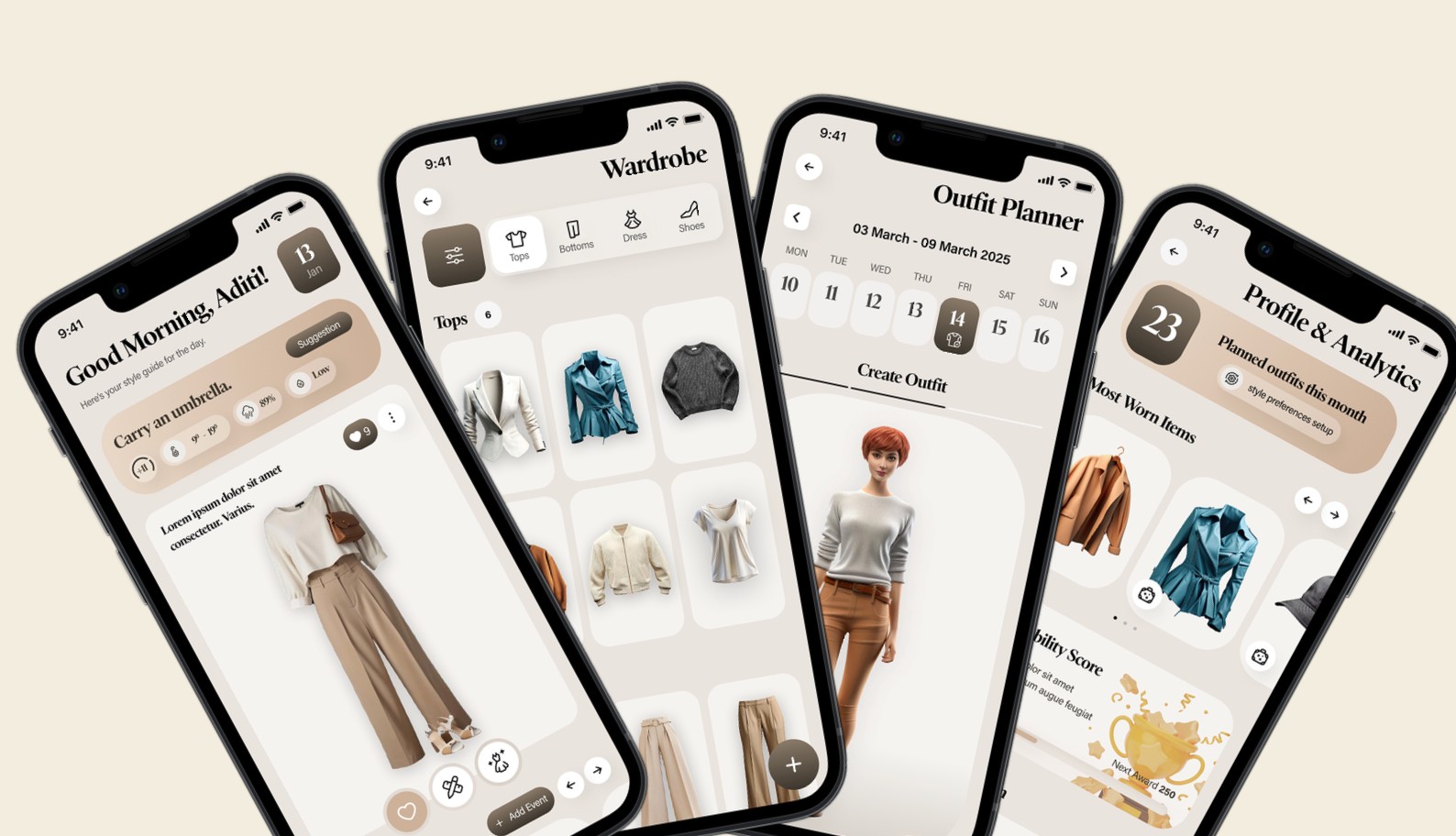
Wardrobe digitization. Smartphone camera → LLM tags every item by category, color, style, fit. Onboarding took under 10 minutes for an average closet.
AI styling engine. Adaptive recommendations weighted on weather, calendar context, and learned preferences. The proprietary ML model improved per user as usage data accumulated.
Sustainability matrix. Tracked which items earned their hanger space and which were collecting dust. Surfaced underutilized pieces as outfit suggestions before recommending anything new.
Event-based planner. Calendar-aware outfit planning for the week ahead — “what am I wearing to the Thursday team dinner” answered before Tuesday.
Daily style guide. Morning glance: today’s weather, today’s commute, today’s outfit pulled from your closet.
Team
- Sachin Gautam (Founder & CEO). Product vision, partnerships, long-term strategy. Background in investment research at Bain & Company (via Genpact) and leadership at UC Davis (TKE chapter president, Chapter of the Year 2024).
- Adwit Aggarwal (CTO). App development, AI infrastructure, backend. Prior software engineering at Intapp, KlearNow, and RevSure.ai.
- Abraham Gomez (Chief Growth Officer). Marketing initiatives and user acquisition. Digital marketing + fashion design + leadership at UC Davis Center for Leadership Learning.
- Maksymilian Wozniak (Public Affairs Officer). Community engagement and partnerships. Finance + tech + startup operations.
Go-to-market
Digital-first. TikTok, Instagram, and YouTube Shorts — short-form content that showed before/after closets and “what to wear today” loops.
Influencer outreach. Partnerships with micro-influencers and fashion bloggers tuned to the Gen Z / young-professional audience. Instagram grew 500+ followers in two weeks of activation.
Campus activations. UC Davis served as the testing ground for the 50K active-user goal by end of 2025. Campus distribution gave us dense, repeat user feedback at low cost.
What this taught me about product
Distribution is half the product. Closet Compass shipped a working AI in 200 hours. The next four months were not “make the product better” — they were “get users into the loop and keep them there.” The AI mattered. So did the path users took to it.
Customer discovery is not validation. Through NSF I-Corps we ran 30+ structured interviews with people who would obviously want this. They all said yes. Then we built the beta and watched what they actually did. The gap between stated preference and revealed behavior is where most consumer startups die. The number that mattered wasn’t the waitlist; it was DAU.
Sustainability has to pay out for the user, not just the planet. Lots of “buy less, wear more” pitches; almost none monetize correctly because the user doesn’t feel the savings. The affiliate model was tricky — it pulled toward “buy this new thing,” contradicting the thesis. Premium subscription ($4.99/mo) ended up the cleaner economic alignment: users pay because the product saves them time and decisions, not because we sold them more clothes.
The exit
I built Closet Compass while finishing my final year at UC Davis. Seven days before my flight back to India after graduation, I met the CEO of nSpire AI at an AI conference (I went to every AI conference I could get into that fall — the longer version is in the side-door PM post). We talked about what I’d shipped, what users had taught me, why I was obsessed with product.
The interview happened the next week. The acqui-hire offer came the day after.
One week I was a confused founder. The next, a PM in Silicon Valley with a backpack, a hotel room, and zero plan. The Closet Compass team joined nSpire to scale the platform. The styling problem is still right — it’s just on a longer roadmap than I thought.